If you are shopping for a new monitor and keep running into the letters VA, you are probably wondering what that label actually means and whether that screen type is right for you. A VA panel is one of the three main LCD technologies on the market today, alongside IPS and TN. Each one has its own strengths and weaknesses, and the right pick depends on what matters most to you, speed, color, or contrast. In this guide we cover everything you need to know about VA panels, how they work, their pros and cons for gaming, how they stack up against IPS and TN panels, and answer the most common questions buyers have before they check out. By the end you should know exactly whether a VA monitor fits your setup and the games you play most.
What Is A VA Panel
VA stands for vertical alignment, and it describes a type of LCD panel where the liquid crystals sit straight up, perpendicular to the glass substrate, when no voltage is applied. Once power is sent through, the crystals tilt and let light pass, which creates the image on your screen. This layout is the reason a VA panel produces such a strong contrast ratio and deep black levels, since crystals sitting upright block most of the backlight from getting through.
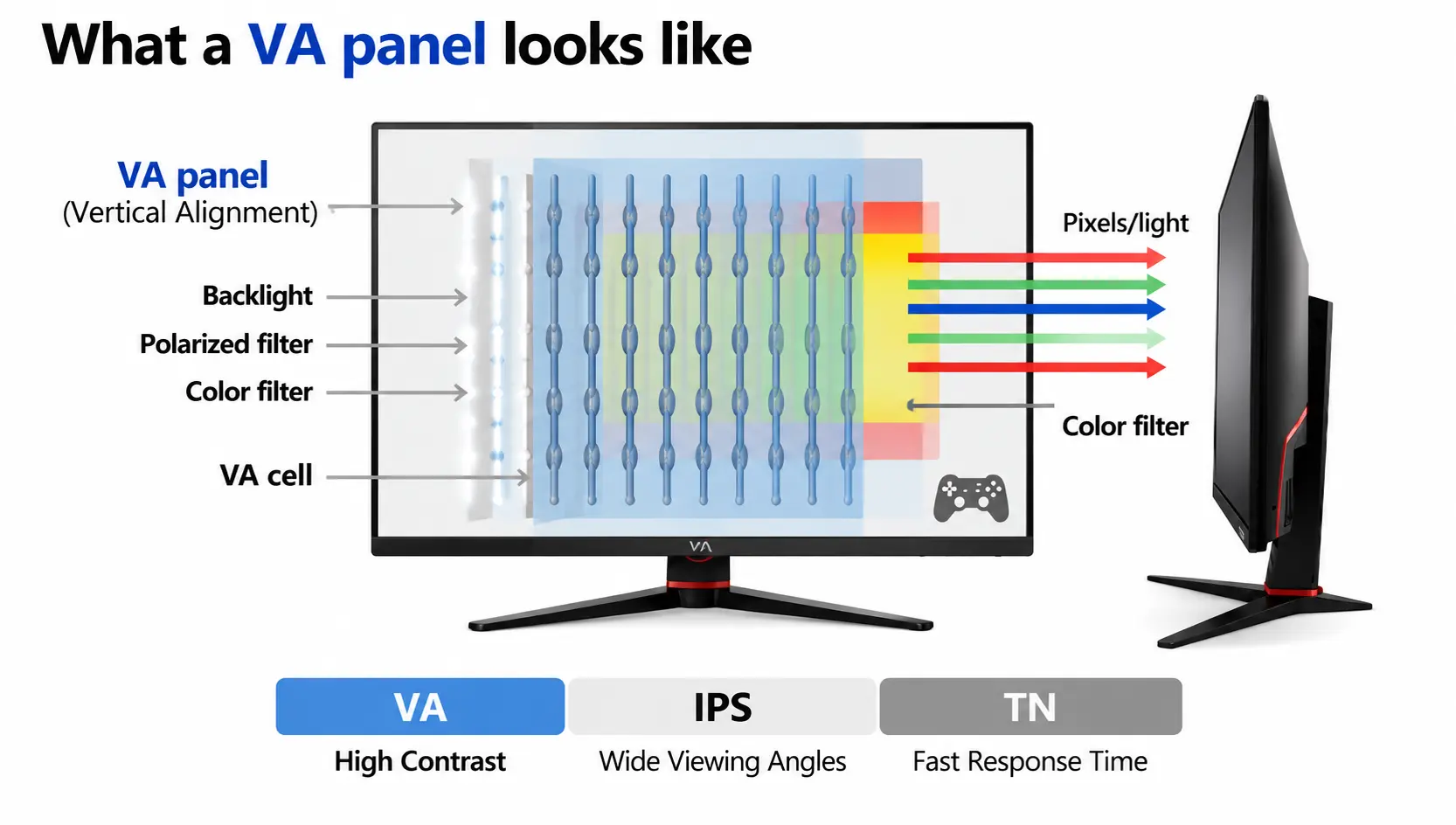
Unlike OLED, which lights up each pixel on its own, a VA panel is still an LCD screen that relies on an LED backlight behind it. That means black will never be quite as pure as on an OLED display, but it still comes out noticeably deeper than what you get from an IPS or TN screen.
VA is also not one single fixed technology. Different manufacturers use their own variations, some label their panels SVA, others MVA, others PVA, and each version brings small differences in contrast, speed, and viewing angles. Two VA monitors in the same price bracket can end up performing quite differently in practice, so it is worth checking independent reviews of the exact model rather than judging a screen purely by the panel type printed on the box.
How A VA Panel Works
The crystals inside a VA panel rest vertically against the glass layer behind them. In that resting position they block nearly all of the light trying to pass through, which is what gives you that clean, deep black instead of the grayish, washed out black you see on cheaper screens. Once the panel’s electronics send a voltage, the crystals tilt, and how far they tilt decides how bright a pixel gets and what color it shows. This is exactly why VA panels post the highest contrast ratio of any LCD type, typically somewhere between 3000:1 and 5000:1, while IPS and TN panels usually sit closer to 1000:1.
VA vs LED vs LCD, What’s The Difference
This is where a lot of buyers get confused, so it is worth clearing up. LCD is the umbrella term for any display that uses liquid crystals to form an image. LED refers to the backlight technology that lights those crystals from behind. VA, on the other hand, describes how the crystals themselves are arranged inside an LED backlit LCD screen. In other words, every VA panel is an LED screen, but not every LED screen is a VA panel, since IPS and TN panels also use LED backlighting. The real difference comes down to crystal layout and how those crystals react once current runs through them.
Pros Of VA Panels For Gaming
VA panels became a popular pick among mid range and higher end monitor makers for good reason. They combine a handful of traits that actually show up in day to day gaming, especially in genres where lighting and mood matter just as much as speed.

High Contrast Ratio And Deep Blacks
This is the single biggest reason people still choose a VA panel. Thanks to how the crystals line up, a VA panel shows noticeably darker blacks than an IPS or TN screen at the same price point. In practice that means shadows in a game look richer, dark scenes hold more detail, and the gap between the brightest and darkest parts of the image feels more pronounced. In a room without much outside light this advantage becomes even more obvious. IPS panels are also known for something called IPS glow, a faint grayish haze that shows up in the corners of the screen in dark rooms, and VA panels largely avoid this thanks to their naturally higher contrast.
Better Color Reproduction Than TN Panels
VA panels do not match the color accuracy of IPS, but they clearly outperform TN panels on this front. Colors look richer and more true to life, which stands out most in games with detailed, colorful worlds. Some newer VA models with a wider color gamut cover more than 90 percent of the sRGB space, which is plenty for gaming, watching movies, and even casual photo editing. For anyone who does not work professionally with color, this gap rarely becomes a real problem.
Wider Viewing Angles Than TN
While a VA panel still trails IPS in this category, it beats TN technology by a wide margin. That matters if you share your screen with someone else or sit slightly off center, since colors and contrast will not fall apart the way they do on a TN screen. This also comes in handy when watching a movie together or playing co op, a situation where TN panels quickly show their weak side through washed out colors and shifting tones the moment your eyes leave the center of the display.
Affordable Pricing
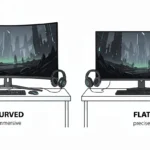
VA monitors tend to land in the budget to mid range price bracket, especially in curved form factors. If your budget cannot stretch to a pricier IPS or OLED screen, a VA panel offers a solid balance of contrast, color, and cost that makes sense for most gamers. If you are also considering a curved screen, check out our guide on whether curved monitors are good for gaming, since VA panels and curved designs are frequently paired together.
Cons Of VA Panels You Should Know About
No display technology is perfect, and a VA panel has its own weak spots worth knowing before you buy, especially if you play competitively.

Slower Response Time Than TN Panels
This is the most common complaint leveled at VA panels. While TN and IPS panels can now hit a response time of 1ms, VA panels typically fall somewhere between 3ms and 8ms, though newer models with better overdrive tuning have managed to close that gap. If you mostly play competitive shooters where every millisecond counts, this is a factor worth weighing. For a full breakdown of what that number actually means and how much it affects gameplay, check our guide on response time on gaming monitors.
Black Smearing And Ghosting On Fast Scenes
Because the crystals move more slowly, VA panels are more prone to black smearing, an effect where dark objects leave a faint trail as they move quickly across the screen. Testing from RTINGS shows this issue still shows up even on newer VA panels, though it is far less noticeable than it was a few years ago. It stands out most in dark scenes with fast motion, think first person shooters or racing games.
Narrower Viewing Angles Than IPS
Although VA beats TN here, it still falls short of IPS. Viewed from a sharp angle, colors and contrast can shift slightly. For a single player sitting dead center this rarely matters, but once you start sharing the screen with more people the gap becomes easier to notice.
Fewer High-End Competitive Models
While the lineup of VA monitors keeps growing, it is still somewhat smaller than the IPS side, particularly among ultra fast models built purely for competitive gaming. Manufacturers tend to save their fastest panels for IPS or TN lines, while VA stays focused on balancing contrast, screen size, and price. This is not a dealbreaker for most buyers, but anyone chasing an extremely high refresh rate paired with the lowest possible response time will find a narrower pool of VA options to pick from.
Response Time Needs By Game Genre
How much response time actually matters depends heavily on what you play. Fast paced shooters and racing games rely on it the most, since a slower pixel transition can blur moving targets or make a car’s motion look smeared during a tight turn. Strategy games, turn based titles, and slower paced RPGs put far less strain on response time, so the gap between a VA panel and a TN panel is barely noticeable in those genres. If your library leans toward fast, twitchy gameplay, this is one of the first specs worth checking before you commit to a VA panel.
Is A VA Panel Good For Gaming
Short answer, yes, a VA panel is a solid choice for gaming, though with a few caveats that depend on your playstyle. A VA monitor offers a good balance of contrast, color, and price, which makes it a practical pick for most gamers who are not playing at a professional level.

Best Game Genres For A VA Panel
A VA panel really shines with single player and story driven titles where mood and visual detail carry a lot of weight. Horror games, adventure titles, and anything with plenty of dark scenes look better on a VA screen thanks to its deeper blacks and stronger contrast. Open world and RPG titles also benefit, since a VA panel pulls out shadow detail that can look flat on an IPS screen.
Is VA Good For Competitive Gaming
For esports and competitive shooters where reaction time is everything, an IPS or TN panel with a lower response time and less input lag is usually the smarter pick. That does not mean a VA panel cannot handle competitive play, plenty of players never notice the difference in practice, but more serious players tend to lean toward the faster options. Pro players in particular tend to steer clear of VA panels because the extra few milliseconds of response time can add up and decide a close duel at the highest level of play.
VA Panels And HDR Gaming
Thanks to its high contrast ratio, a VA panel provides a strong base for HDR visuals. Deep blacks paired with bright highlights create a more striking image than you typically get from an IPS panel in the same price range. If you want to know exactly what HDR involves and how display quality is measured, take a look at our guide on HDR on gaming monitors.
VA vs IPS, Which Is Better For A Gaming Monitor
Comparing VA and IPS panels is one of the most common questions when picking a monitor, since these two technologies dominate the current market. Here is how they measure up category by category.

Contrast And Black Levels
A VA panel wins outright here. A contrast ratio of 3000:1 to 5000:1 far outpaces IPS, which typically sits around 1000:1. If you game in a dark room or love titles with heavy shadow work, a VA panel will give you the better looking picture.
Color Accuracy
This category goes to IPS. It delivers more precise color reproduction and broader sRGB and DCI-P3 coverage, which makes it the better choice for photo editing, video work, and design. For pure gaming the gap matters less, though it is still noticeable in detailed, vividly colored titles.
Viewing Angles
IPS takes this round too. Colors and contrast stay consistent even at sharp viewing angles, while a VA panel loses some picture quality toward the edges of the screen. On large curved displays this gap matters less, since the curve naturally keeps you closer to center throughout the time you spend at the screen.
Response Time And Refresh Rate
Modern IPS panels tend to reach a lower response time more easily, though the gap keeps shrinking each year. Newer VA panels with better overdrive settings can hit 1ms to 4ms in their higher end models, while average VA panels remain a bit slower. For a closer look at how much of a real difference response time actually makes in gameplay, check our guide on IPS panels for gaming.
Price
VA monitors are generally more affordable, especially in larger curved sizes. IPS screens with comparable specs usually cost a bit more due to their stronger color handling and wider viewing angles. According to testing from Tom’s Hardware, IPS came out ahead in four out of five categories in a direct head to head, with VA taking a clear win only on contrast.
Which Panel Is Better For 4K Gaming
At 4K resolution, IPS tends to be the more common choice. A big part of that comes down to motion clarity, since IPS panels handle fast pixel transitions a bit more cleanly at high resolution, which matters when there is more detail on screen to track. VA panels can still deliver a great 4K picture, especially for slower paced or story driven titles, but if you plan to pair a 4K screen with a high refresh rate for fast action games, IPS remains the safer route for most buyers.
VA vs TN vs IPS, Comparison Table
For a quick overview, here is how all three technologies compare on the specs that matter most for gaming. These figures are averages for each panel type, so a specific model can land above or below depending on the manufacturer and price tier.
| Panel | Response Time | Contrast Ratio | Color | Viewing Angles | Price |
|---|---|---|---|---|---|
| VA | 3ms to 8ms | 3000:1 to 5000:1 | Good | Average | Low to mid |
| TN | 1ms to 3ms | around 1000:1 | Weaker | Narrow | Lowest |
| IPS | 1ms to 4ms | around 1000:1 | Excellent | Widest | Mid to high |
If you want to dig deeper into TN panels, take a look at our guide on TN panels for gaming, where we cover why the technology still holds a place among competitive players despite its weaker color output.
VA Panel vs OLED For Gaming
OLED and VA panels get compared a lot since both are known for strong contrast, but they work in completely different ways. An OLED pixel produces its own light, while a VA panel still depends on an LED backlight. That is why OLED reaches a near infinite contrast ratio and true black, whereas a VA panel is capped by its finite contrast, no matter how high that ceiling actually is.
That said, OLED carries a risk of burn in, permanent ghosting of static elements like a HUD or taskbar, which is a real concern for monitors that also double as work screens. A VA panel does not carry that risk at all. If you want a monitor in the budget to mid range price bracket that still delivers strong contrast without worrying about burn in, a VA panel remains the safer pick. For someone chasing the absolute best picture quality and who does not mind a bigger budget, OLED is still the more advanced technology.
The price gap between the two is still significant. OLED gaming monitors have only recently started becoming more affordable, but they still cost more than VA models of similar size and resolution. For someone buying their first mid range monitor, a VA panel is a more practical entry point into high contrast visuals, while OLED is more of an investment for someone who already knows picture quality is their top priority and is ready to pay for it.
How To Choose The Right VA Gaming Monitor
Before you buy, it is worth thinking through a handful of factors that will directly affect how happy you end up being with a VA monitor day to day.
Room Lighting
If you game in a dim room or mostly at night with the lights off, a VA panel will give you a better experience thanks to its deeper contrast. In a bright room with a lot of natural light, the gap between VA and IPS shrinks, since contrast naturally feels less impactful under strong ambient lighting.
The Type Of Games You Play
For story driven and atmospheric titles, a VA panel is a great fit. For competitive shooters where speed decides the outcome, an IPS or TN panel with a lower response time is worth considering instead. If your library is a mix of everything, a VA panel still offers a solid middle ground. It helps to jot down a short list of the games you play most and figure out which factor matters more for them, reaction speed or visual mood, before settling on a panel type.
Refresh Rate And Extra Features
Refresh rate matters just as much as panel type, since it directly affects how smooth motion looks during fast action. Before buying, check how high a refresh rate you actually need for the games you play, we cover that in detail in our guide on refresh rate on gaming monitors. It is also worth checking whether the monitor supports a variable refresh rate feature, since that helps cut down on screen tearing during gameplay.
Budget And Price Range
VA monitors span a wide price range, from budget friendly 1080p models to pricier 4K curved screens with a high refresh rate. Before you buy, set a budget and figure out which specs actually matter to you, rather than picking a monitor purely on price or whatever claims are printed on the box. If this whole process still feels overwhelming, we put together a full guide on how to choose a gaming monitor that walks through every spec step by step, from panel type and resolution to ports and desk setup.
Is A VA Panel Good For Work And Gaming Combined
Plenty of people are not buying a monitor for gaming alone, it also has to handle spreadsheets, browser tabs, and video calls during the day. A VA panel actually holds up well in this dual role. Its strong contrast makes dark mode interfaces and text feel sharper, and the deeper blacks are easier on the eyes during long stretches of reading or coding under dim lighting.
Where a VA panel starts to fall behind is color critical work. If your job involves photo editing, video color grading, or any design task where color accuracy matters, an IPS panel is still the better all around pick, since its wider color coverage and stable viewing angles make it more reliable when a client or teammate is looking over your shoulder. For someone who splits their time evenly between gaming at night and general office work during the day, a VA panel is a practical middle ground, while creative professionals who also game are usually better served by IPS.
Conclusion, Which Panel Is Right For You
A VA panel is one of the most practical choices today for gamers who want strong contrast, decent color, and a lower price tag, without needing the fastest possible response time. If you mostly play atmospheric, story driven, or horror titles and your room tends to run darker, a VA monitor will give you a richer looking picture than an IPS screen at the same price. On the other hand, if you play mostly competitive games where every millisecond counts, an IPS or TN panel remains the safer bet.
Before deciding, it helps to write down three things, your budget, the type of games you play most, and how bright your room usually is. Those three factors will tell you nine times out of ten whether a VA panel is the right call or whether you should look at an IPS or TN alternative instead. In the end, the best panel is the one that matches your playstyle, your room, and your budget, not whichever option happens to be trending or getting the most praise in reviews right now.
Frequently Asked Questions About VA Panels
Are VA panels bad for gaming?
No, VA panels are not bad, they simply strike a different balance than IPS and TN panels. They offer strong contrast and deep blacks, along with a somewhat slower response time. For most gamers who are not playing at a competitive level, a VA panel is a perfectly solid choice.
Why choose VA over IPS?
The main reason is contrast. If you enjoy games with dark, atmospheric scenes or play mostly at night with the lights off, a VA panel will give you a better looking picture than an IPS screen at a similar price. Cheaper pricing on curved models is another common reason buyers go this route.
Is a VA monitor good for office work?
Yes, a VA monitor works just fine for text, spreadsheets, and everyday tasks, since its strong contrast makes text feel sharper and dark themes look more defined than on an IPS screen. For professional color work, like photo or video editing, IPS remains the better pick thanks to its more accurate color reproduction.
Can VA panels display HDR content?
They can, and fairly well thanks to their naturally high contrast. HDR quality still depends on other factors too, like peak brightness and the number of local dimming zones, not just the panel type alone.
Do VA panels suffer from ghosting?
Older VA panels had a noticeable ghosting and black smearing problem, but newer models with better overdrive tuning have cut that down significantly. It is worth checking independent response time tests before buying, since performance still varies a lot from model to model even within the same price bracket.
Which brands make the best VA gaming monitors?
Samsung, AOC, and ASUS are among the brands most often recognized for solid VA panels, thanks to consistent quality control and strong overdrive tuning that keeps ghosting in check. That said, the brand name matters less than the specific model, so it is worth reading reviews of the exact monitor you are considering rather than assuming every VA screen from a well known brand performs the same way.
Is VA the same as LED?
Not quite. LED refers to the type of backlight, while VA describes how the liquid crystals are arranged inside the panel. Every VA panel uses an LED backlight, but not every LED screen is a VA panel, since IPS and TN panels also rely on LED backlighting.
How long does a VA monitor last?
A VA monitor’s lifespan is similar to IPS and TN panels, usually somewhere between five and ten years of regular use, depending on build quality and daily usage hours. Unlike OLED, a VA panel carries no burn in risk, which makes it well suited for displaying static elements like a taskbar or in game HUD for long stretches of time.